Pocket-Gull
Interactive 3D Anatomy & Friendly AI Health Helper
A real-time health companion that combines a 3D interactive human body with Google Gemini AI to help patients and doctors explore health questions together.
Architecture Highlights
- •Frontend: Angular 22 with fast reactive signals and lightweight components.
- •AI Layer: Google Gemini AI responding in real time to voice and text.
- •3D Body Model: Interactive skeletal meshes and joint shaders using Three.js.
- •Safety: Private, local-first design keeping personal health data safe.
Engineering Hurdles Solved
- •Keeping 3D graphics buttery smooth at 60 frames per second on mobile phones.
- •Making sure health explanations are easy to read and accurate for families.
Overview
Pocket-Gull is a friendly health companion designed to make medical ideas clear and approachable. By pairing an interactive 3D model of the human skeleton with Google Gemini AI, it helps patients and doctors explore health questions together with clear pictures, simple words, and clinical precision.
To eliminate dangerous medication errors caused by confusing numerals and letters in dosage instructions, the Pocket-Gull ecosystem is powered by the PocketGull Font Superfamily (available at font.pocketgull.app). Built around Louise Sloan 5:1 optotypes and Institute for Safe Medication Practices (ISMP) standards, it guarantees unambiguous differentiation between zero and O, 1 and l, and Z and 2.
Key Architectural Breakthroughs
1. Full-Duplex Multimodal Consult Engine
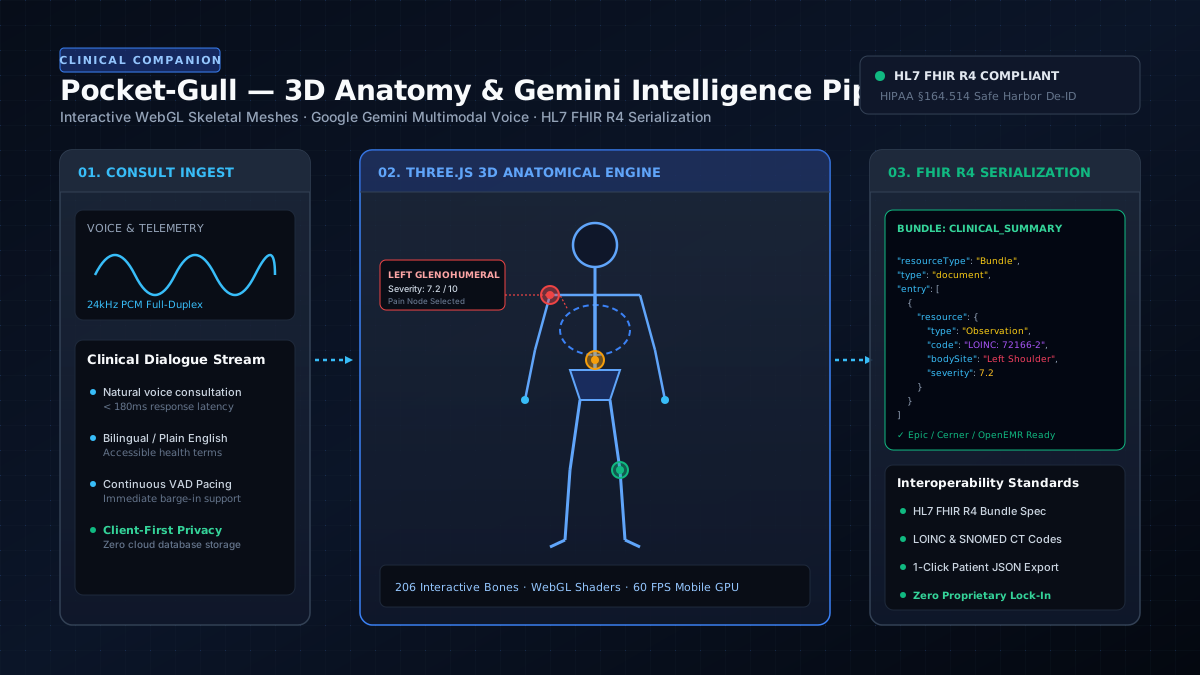
Pocket-Gull leverages Google Gemini Live WebSocket streams to provide natural bi-directional voice consultation. The system handles low-latency audio capture, streaming transcription, clinical entity extraction, and continuous physiological telemetry visualization simultaneously.
2. Procedural 3D Skeletal & Surface Anatomy
Using Three.js, the application generates interactive skeletal and dermatome surface models directly in WebGL. Clinicians and patients can rotate, slice, and inspect localized pain nodes, anatomical anomalies, and symptom clusters in real-time 3D space.
// Sample signal-driven telemetry and 3D node activation
@Component({
  selector: 'app-anatomy-node',
  standalone: true,
  template: `
    <div class="p-3.5 bg-white dark:bg-zinc-900 border border-blue-500/40 rounded-xl shadow-sm">
      <span class="font-kanit font-bold text-blue-600 dark:text-blue-400">{{ anatomicalRegion() }}</span>
      <p class="text-sm text-zinc-600 dark:text-zinc-300">Severity Index: {{ severityScore() }}/10</p>
    </div>
  `
})
export class AnatomyNodeComponent {
  region = input.required<string>();
  severity = input<number>(0);

  anatomicalRegion = computed(() => this.region().toUpperCase());
  severityScore = computed(() => this.severity().toFixed(1));
}
3. FHIR R4 Bundle Serialization
Every symptom record, vitals timeline, and AI clinical report is serialized into strict HL7 FHIR R4 Bundle format, ensuring instantaneous interoperability with electronic health record (EHR) systems like Epic, Cerner, and OpenEMR.
Technology Stack
- Client & SSR: Angular 22, TypeScript, Express SSR, Tailwind CSS.
- AI & Reasoning: Google Gemini Pro & Flash, Genkit, ADK Live Streaming.
- 3D Graphics: Three.js, WebGL Shader Language (GLSL).
- Standards & Privacy: FHIR R4, DOMPurify, HIPAA §164.514 Safe Harbor De-identification.
Explore More Systems
View full portfolio of AI architectures, creative technology, and open systems.