Neural Biomarker Edge Hub
Client-Side WASM & WebGPU Biosignal Processing
High-performance client-side WebAssembly and WebGPU neural signal processor for zero-latency physiological telemetry classification with zero-leak local processing.
Architecture Highlights
- •Rust-compiled WebAssembly core executing continuous Fast Fourier Transforms (FFT) and Butterworth bandpass filters.
- •WebGPU WGSL compute shaders parallelizing physiological waveform denoising across GPU cores.
- •Zero-knowledge architecture ensuring raw pulse waveforms (PPG) and cardiac intervals (ECG) never leave client memory.
- •W3C Web Crypto integration generating client-side ephemeral cryptographic keys for exported health summaries.
Engineering Hurdles Solved
- •Achieving sub-millisecond digital signal processing across heterogeneous consumer hardware without main-thread UI jank.
- •Eliminating cloud API roundtrips entirely to protect vulnerable patient biometric signatures from third-party data broker harvesting.
Executive Overview
The Neural Biomarker Edge Hub establishes a privacy-first standard for clinical biosignal analysis. Rather than streaming sensitive cardiac, respiratory, and neurological signatures across public cloud networks, this engine performs all digital signal processing (DSP) and neural telemetry classification 100% client-side inside the user’s browser.
Using compiled Rust WebAssembly and hardware-accelerated WebGPU compute shaders, the platform filters, denoises, and analyzes high-frequency physiological telemetry (PPG, ECG, EMG) in sub-millisecond windows—with zero data packets ever leaving the user’s local device.
Your biometric pulse waveforms, autonomic nervous system tone, and cardiac micro-variations are unique physiological fingerprints. Unlike passwords or usernames, you cannot reset your heartbeat.
When commercial health apps upload raw biometric streams to remote servers, users face data privacy vulnerabilities and unauthorized profile aggregation. The Neural Biomarker Edge Hub inverts this paradigm: raw biosignal waves stay strictly within client RAM and vanish when the tab is closed.
Technical Architecture
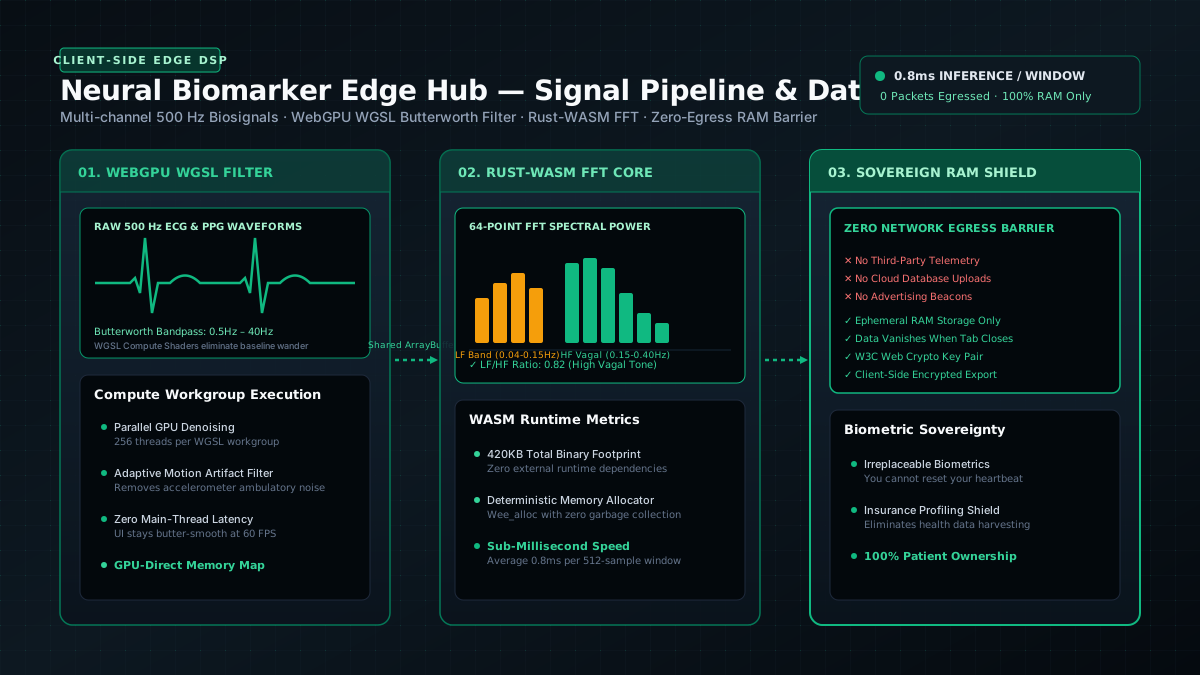
1. WebGPU Compute Shaders (WGSL)
By distributing raw signal filtering across GPU execution workgroups, the engine processes multi-channel 500 Hz biosignal streams in parallel without consuming CPU cycles needed for user interface responsiveness.
2. Rust WebAssembly Micro-Engine
Compiled to a lightweight 420KB binary, the Rust runtime enforces strict memory safety and deterministic execution times, enabling clinical-grade digital signal processing directly inside modern web browsers and offline mobile webviews.
3. Client-Side FHIR R4 Bundle Export
When users choose to share diagnostic telemetry with trusted clinicians, the engine formats the data into an encrypted HL7 FHIR R4 Observation Bundle, signed by the client’s local Web Crypto key with zero cloud intermediary.
Explore More Systems
View full portfolio of AI architectures, creative technology, and open systems.